
Beauty Dropshipping Margins: What a $29 Serum Really Earns
A worked example of beauty dropshipping margins: what a $29 serum earns after refunds, fees and ads, plus break-even ROAS at four prices and a pricing rule.
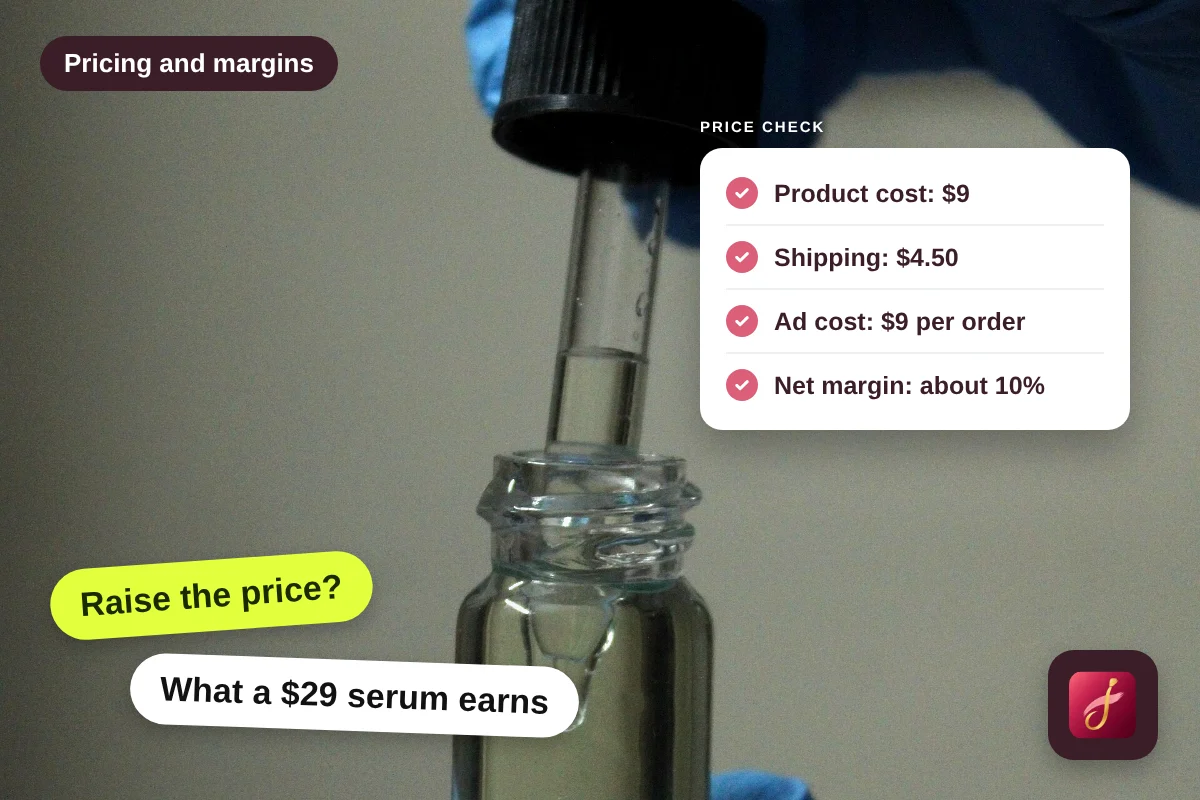
Beauty dropshipping profit margin looks generous on a supplier's price list and thin on a bank statement. A serum that costs $9 and sells for $29 is a markup of more than 200 percent, yet once you add shipping, payment fees, refunds and the ads that brought the customer in, the same order can leave about three dollars. This guide builds the real number for one example serum, shows the break-even ad cost and ROAS at four prices, gives you a rule for when to raise the price or walk away, and budgets the sample run that should come before any of it.
The example product and the assumptions
Say you sell a 30 ml vitamin C serum from a US supplier. The supplier charges $9 for the product and $4.50 to ship one order to your customer. Four more assumptions shape the result: a payment fee of 2.9 percent plus 30 cents per order, a refund rate of 8 percent, an ad cost of $9 to win one order, and no extra tools or packaging. Fee rates depend on your Shopify plan and your country, so check the current rates on Shopify's pricing page before you copy these figures.
The refund rate deserves a word. The National Retail Federation projected that 19.3 percent of online sales would be returned in 2025 across all of retail. There is no single trustworthy figure for beauty, so 8 percent here is an assumption to replace with your own data. An opened serum cannot go back on a shelf, so the math treats a refunded order as lost: you give the money back, and the product and delivery cost stay spent.
What one order really earns
One formula covers it. Profit per order equals the price times one minus the refund rate, minus fees, minus the product cost, minus supplier shipping, minus the ad cost. At a $29 price that works out as follows: $29 times 0.92 leaves $26.68 after average refunds, fees take $1.14, the product and shipping take $13.50 and the ad takes $9. The profit is $3.04 per order, or a 10.5 percent net margin.
| Retail price | Profit per order | Net margin |
|---|---|---|
| $24 | -$1.42 | -5.9% |
| $29 | $3.04 | 10.5% |
| $34 | $7.49 | 22.0% |
| $39 | $11.95 | 30.6% |
Look at the markups next to those margins. A $24 price is a 167 percent markup on the $9 product, and it loses money. A $29 price is a 222 percent markup and earns about a tenth of the price. Markup compares what you charge with the product cost alone. Margin measures what is left after everything it took to make the sale, which is the number that pays you.
Break-even ad cost and ROAS
Break-even ROAS is the point where the revenue from ads exactly covers your costs. Shopify's guide to ROAS shows the same idea: divide the sale price by the amount left for ads after your other costs, and the result is the ROAS at which you break even. For this serum, the break-even ad cost is the price kept after refunds, minus fees, product and shipping. Divide the price by that figure and you have the ROAS you need just to stay level.
| Retail price | Break-even ad cost | Break-even ROAS |
|---|---|---|
| $24 | $7.58 | 3.16 |
| $29 | $12.04 | 2.41 |
| $34 | $16.49 | 2.06 |
| $39 | $20.95 | 1.86 |
With ads costing $9 per order, the $24 price is already underwater, because break-even is $7.58. At $29 there is about $3 of room. At $34 there is roughly $7.50. Raising the price from $29 to $34 more than doubles the profit per order and lowers the ROAS you need from 2.41 to 2.06, so a small price change buys a lot of safety.
A pricing rule you can apply today
Once you have the net margin after ads, a simple rule tells you what to do with it. These thresholds are working rules of thumb rather than industry standards, so tune them to how much risk your budget can carry.
| Net margin | Next step |
|---|---|
| Below 10% | Raise the price or skip the product |
| 10% to 20% | Test with a small budget |
| Above 20% | Worth scaling |
Run the serum through it. The $24 price is below zero, so it is out. The $29 price sits at 10.5 percent, which earns a small test but not a big budget. The $34 price clears 20 percent, so it is the one to scale. Higher prices can lower conversion, so test the new price with real traffic before you assume the extra margin is real.
Find your own price floor
You can turn the same math around and ask what price you need. To reach a target net margin, add the product cost, supplier shipping, ad cost and the fixed 30 cent fee, then divide by one minus the refund rate, the percentage fee and the margin you want. For the serum and a 20 percent target, that is ($9 + $4.50 + $9 + $0.30) divided by (1 - 0.08 - 0.029 - 0.20), which is $22.80 divided by 0.691, or about $33. Check it: at $33 the serum keeps $30.36 after refunds, pays $1.26 in fees and $22.50 in costs and ads, and leaves $6.60, exactly 20 percent of the price.
The floor moves with the product cost. With the same assumptions, a $6 product needs a price near $28.65 for a 20 percent margin, the $9 serum needs about $33, and a $14 product needs about $40. If a competitor sells the same kind of product for less than your floor, the answer is not to match them. It is to find a cheaper supplier, lower your ad cost, or pick another product.
To run this on a real product, work through three steps. First, get the product cost and the shipping cost for each country you sell to from the supplier, and ask what they cover if an order arrives damaged. Second, write down your refund rate and ad cost as honest guesses, and mark them to be replaced after your first fifty orders. Third, calculate the price floor for a 20 percent margin, compare it with what similar products sell for, and decide whether the product can compete at that price. If it cannot, you have lost nothing but ten minutes.
What moves the numbers most
Three inputs swing the result more than the rest. The first is the refund rate. If refunds rise from 8 to 15 percent, the $29 serum drops from $3.04 to about $1.01 per order, a 3.5 percent margin, because each refunded order still carries its product and shipping cost.
The second is ad cost. Every extra dollar you spend to win an order comes straight off the profit, and at $29 an ad cost of $12.04 erases it entirely. Track your real cost per order from the first week, since a number that looked fine in a spreadsheet can change as soon as ads run.
Supplier shipping is the third. A supplier close to your customers usually delivers faster and costs less to ship. Check the delivery cost for each country you sell to, because a flat $4.50 rarely applies everywhere.
Discount codes quietly cut the margin
Everything above uses the full price, and many beauty stores offer a welcome code. A 10 percent code on a $34 serum brings the price paid to $30.60. At that price the same costs leave $4.46 per order, a 14.6 percent margin instead of 22 percent. If you plan to discount, run the table with the discounted price, and do not count on the code to win customers who would have bought anyway.
Set the refund rule before you launch
Opened cosmetics are rarely resalable, so many beauty stores offer a replacement or partial refund for damaged or wrong items instead of open-ended returns. Write the rule into your policy, find out what your supplier will cover, and use the refund rate that policy implies in the math above. A written policy also makes your forecast more honest.
Budget the samples before you price
Prices built from a supplier's list are guesses until you hold the product. Order samples before you commit, and count what they cost. Say you compare three suppliers and order two samples from each, assuming each sample costs the same $13.50 as the product and delivery on a real order. Six samples cost $81, which is roughly the profit from 27 orders at the $29 price. That is cheap insurance against building a brand on a product that leaks, smells wrong or arrives crushed.
When the samples arrive, check the things your customers will notice first: whether the packaging survives the trip, how the product feels and smells, whether the label matches what you plan to say on the product page, and how long delivery took. Reject any supplier whose samples fail two of these checks. If you are thinking about putting your own name on a product later, our guide to crafting your signature line covers what customization can look like.
Jubilee lets you order product samples from the dashboard in a few clicks, and 80 percent of its dropshipping suppliers are based in the US or Europe. To test these numbers against real supplier prices, try Jubilee and rerun the tables with the costs you find.
Beauty margin FAQs
What is a good profit margin for beauty dropshipping?
There is no official benchmark, so set your own floor from your costs. A common starting rule is to test products that show a net margin of 10 to 20 percent after refunds, fees and ads, and to scale the ones above 20 percent. Recalculate once real orders replace your assumptions.
Should I include refunds in my margin calculation?
Yes. Opened cosmetics usually cannot be resold, so a refunded order often costs you the product and the delivery as well as the sale. Use your own refund rate after your first fifty orders, and rerun the numbers if it changes.
How do I find my break-even ROAS?
Subtract fees, product cost and shipping from the price you keep after refunds, which gives your break-even ad cost per order. Divide the price by that number and you have the ROAS you need to avoid a loss. Any result above that is profit.
Can I price a beauty product too high?
Yes. A higher price improves your margin but can lower conversion, so test a new price with real traffic before you rely on it. Move in steps of a few dollars and watch both the order count and the profit per order.