
How to Test Beauty Product Samples Before You Sell Them
Score beauty product samples on packing, labels, delivery time and landed cost, then decide whether to list, retest or drop a supplier. Worked example inside.
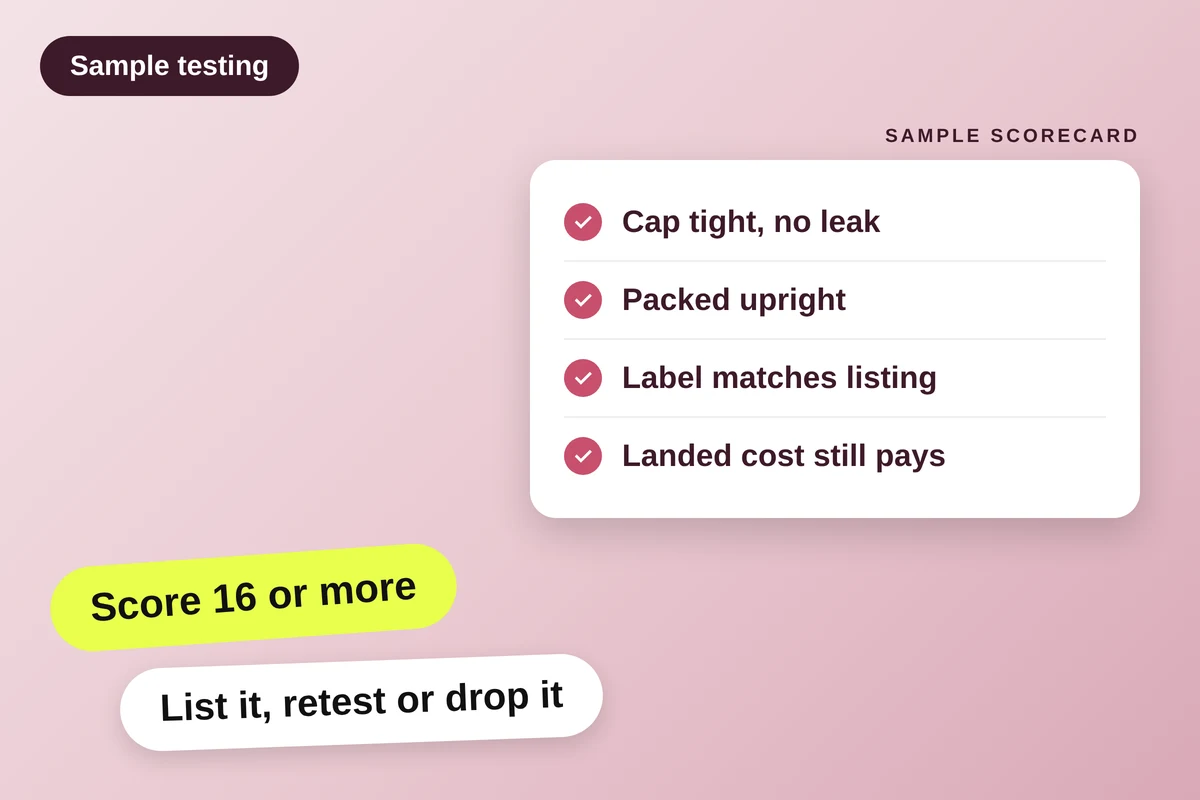
A beauty supplier's product page shows you a clean bottle on a white background. The sample parcel shows you what your customers will actually open. If you plan to list a product, the sample is the only moment when finding a problem costs you one parcel instead of a stream of refunds. This guide gives you a way to test beauty product samples before you sell them: a 10-line scorecard, a worked example with two suppliers, and a rule for when to list, retest or walk away.
The test is about the supplier and the parcel, not about the formula. You are checking packaging, labels, timing and cost. Whether a product works on skin is not something a reseller can judge from one bottle, and nothing in this guide asks you to.
What a sample test is for
Think of the sample as a rehearsal of one customer order. You are not judging how it performs on skin. You are asking five practical questions. Did it arrive intact? Does the label match the listing? Did it arrive when promised? Can I photograph it well? Does the money work after shipping?
Each of the five costs you something. A leaking cap becomes a refund request, and a twelve business day delivery becomes a "where is my order" email. Both show up in a sample parcel if you look on purpose.
Jubilee lets you order samples from the dashboard in a few clicks, so the cost of testing is the price of the sample and its shipping. If you have not yet worked out what one product earns after refunds, fees and ads, start with our beauty dropshipping margins example, which also budgets a six-sample order. This guide picks up where that one stops: what to do when the samples land on your desk.
Before the parcel arrives
Set up the test before you order, because some of the evidence disappears the moment you open the box. Make a simple sheet with one row per sample and a column for each line of the scorecard below. Then write down three things at checkout: the date you ordered, the delivery date the supplier or listing promised, and what you paid for the product and for shipping.
When the parcel arrives, photograph it before you touch anything. Take one photo of the outer box from the side that shows any dents, one of the packing inside the box, and one of the product still in its wrapping. Those three photos are your record if you later need to show a supplier that the damage was not yours.
Keep the box and packing material until the test is finished, because how a product was packed matters as much as the product.
The 10-line scorecard
Score each line 0, 1 or 2. Two points means it passed cleanly. One point means a small flaw you could live with. Zero means a flaw a customer would notice. The maximum is 20. The table shows what earns two points and what earns zero on each line.
| Line | 2 points | 0 points |
|---|---|---|
| 1. Closure | Cap tight, no residue | Leak or loose cap |
| 2. Packing | Cushioned, upright | Loose in a box |
| 3. Outer box | Intact, no dents | Crushed or torn |
| 4. Name and size | Match your listing | Different product |
| 5. Ingredient list | Printed on the pack | Missing |
| 6. Claims on pack | Nothing about cures | Treat or cure wording |
| 7. Look and feel | Matches the photos | Separated or off |
| 8. Delivery time | On or before promise | Over by a week |
| 9. Tracking | Updated all the way | Dead for days |
| 10. Photo test | Clean shots in 10 minutes | Label peels, scuffs |
A few of these lines need a note, because they are easy to score on a hunch.
For closure, turn the bottle upside down over a paper towel for a minute with the cap on, then check the cap threads and the inside of the box for residue. A bottle that survived one trip in a padded box may still leak in a rougher one, so a small stain earns one point, not two.
Packing comes down to what stopped the bottle from moving. A pump bottle wrapped in a bag and set in a snug box is a pass. A bottle rolling around in a box twice its size is a fail even if it arrived unbroken, because the next parcel may not be so lucky.
On the photo test, set a timer. If ten minutes does not give you a usable shot, you will fight that product on every listing you write.
Reading the label the way a regulator would
Lines 4, 5 and 6 are about the label, and they deserve a closer look. The U.S. Food and Drug Administration regulates cosmetic labeling under the Federal Food, Drug, and Cosmetic Act and the Fair Packaging and Labeling Act, and says cosmetic labeling must be truthful and not misleading. The same page notes that products intended to affect the structure or function of the body, or for a therapeutic purpose such as treating or preventing disease, are regulated as drugs.
For you, as a reseller, that gives three plain checks. Does the pack carry an ingredient list at all? Does the name and size on the pack match the product you plan to describe? And does any wording on the pack or an insert promise to treat, cure or prevent something? A product that fails the third check is a problem for the supplier today and for you the day you copy its words onto your page.
One more label detail trips up new sellers. The FDA's labeling page also says that current U.S. law does not require manufacturers to print expiration dates on cosmetic labels. So a missing date is not proof of a problem, but it does mean you should ask the supplier how they track batches and how fresh the stock is when it ships. Write the answer in your sheet.
The FDA also explains in its overview of U.S. cosmetics law that imported cosmetics must meet the same U.S. laws and regulations as those made domestically, and that firms are responsible for marketing safe, properly labeled products. Under the Modernization of Cosmetics Regulation Act of 2022, a responsible person must report serious adverse events to the FDA within 15 business days. You do not need to read the statute to run a sample test. You do need a supplier who can tell you, in writing, who that responsible person is for the product you sell.
This guide is not legal advice, and the rules differ outside the United States. If you sell into the EU or the UK, check the labeling rules for those markets before you list.
A worked example with two suppliers
Suppose you are choosing between two suppliers for the same type of product, a 50 ml face moisturiser that you plan to sell for $24.99. Imagine the samples arrive and you score them. Supplier A charges $8.40 for the product and $4.20 for shipping. The parcel was promised in 5 business days and arrived in 5. The cap left a small stain on the box, and the bottle had shifted in a box slightly too big. Supplier B charges $7.10 for the product and $6.80 for shipping. It was promised in 5 business days and arrived in 12. The bottle arrived intact in a snug box, but tracking stalled for two days and the label scuffed when handled.
| Line | Supplier A | Supplier B |
|---|---|---|
| 1. Closure | 1 | 2 |
| 2. Packing | 1 | 2 |
| 3. Outer box | 2 | 2 |
| 4. Name and size | 2 | 2 |
| 5. Ingredient list | 2 | 2 |
| 6. Claims on pack | 2 | 2 |
| 7. Look and feel | 2 | 2 |
| 8. Delivery time | 2 | 0 |
| 9. Tracking | 2 | 1 |
| 10. Photo test | 2 | 1 |
| Total | 18 | 16 |
Add the columns. Supplier A scores 1 + 1 + 2 + 2 + 2 + 2 + 2 + 2 + 2 + 2 = 18. Supplier B scores 2 + 2 + 2 + 2 + 2 + 2 + 2 + 0 + 1 + 1 = 16. Both land in the "list it" band, so the scorecard alone does not pick a winner. The money does.
Landed cost is the product price plus shipping. For A that is $8.40 + $4.20 = $12.60. For B it is $7.10 + $6.80 = $13.90. At a $24.99 price, A leaves $24.99 minus $12.60, which is $12.39 before fees, refunds and ads. B leaves $24.99 minus $13.90, which is $11.09. So A is $1.30 better per order, even though B has the cheaper product.
The delivery gap matters too. B took 12 business days against a promise of 5, which is 7 days over. If you write "arrives in 5 business days" on your product page because the listing said so, your customers wait more than twice as long as you told them. Supplier A lets you promise what you can keep. The supplier you want is not the one with the cheapest bottle. It is the one whose numbers you can plan around.
What the total tells you
Use the total as a rule of thumb, not a law. These bands are our suggestion for sorting suppliers, not an industry standard, and you can move them to fit your own tolerance for risk.
| Score | Verdict | Next step |
|---|---|---|
| 16 to 20 | List it | Write the page |
| 12 to 15 | Retest | Order a second sample |
| Under 12 | Drop it | Move to the next supplier |
The exception in the caption is deliberate. A product whose pack promises to treat or cure something carries a risk that no total can offset. If the supplier will not fix the wording, drop the product and keep looking.
A score in the middle band is the interesting one. A 13 often means one real problem and a few small ones. Order a second sample, ideally of a different batch if the supplier can tell you which is which, and rescore the lines that cost you points. If the same lines lose points twice, the flaw is how the supplier works, not bad luck.
Why delivery time gets its own lines
Lines 8 and 9 are the ones sellers skip, because a sample parcel feels like a special case. Treat it as a fair preview anyway.
Write the promised date at checkout and the delivered date on arrival, and count in business days. Then use the gap, not the best case, when you write your shipping line. In the U.S., the FTC's guide to the Mail, Internet or Telephone Order Merchandise Rule says that if you state or imply a shipping time, you need a reasonable basis for it. One sample is a thin basis, so treat it as a first reading and keep logging real orders after you launch.
Mistakes that make a sample test useless
Testing only one sample is the most common. One parcel tells you what happened once. If the first sample scores 19, order a second anyway before you buy ads, because a clean run can be luck.
People also open the parcel before photographing it, and then have no proof to show the supplier.
Scoring on a good feeling is another trap. A lovely bottle can still fail the delivery and label lines, so fill in the sheet line by line before you decide what you think of the product.
The last mistake is skipping the money. A supplier can score 20 and still leave no margin. Always finish with landed cost, then run the price through the same arithmetic you would use for a live order.
From passing sample to live listing
A sample that scores 16 or more and clears the minimum margin you set before ordering is a candidate for a listing. The margins post linked earlier shows how to work out that number. A zero on the delivery line is a reason to ask the supplier why before you list, whatever the total. Use your own photos of the sample, write the page from facts you confirmed, and state the delivery time you measured. If the sample passed on the label lines, copy the facts from the pack and do not add claims of your own.
Jubilee lets you order product samples from the dashboard, and 80 percent of its dropshipping suppliers are based in the US or Europe. To run this scorecard on real parcels, try Jubilee and order your first samples.
Beauty sample testing FAQs
How many samples should I order before I list a product?
Order one per product you are seriously considering, then a second of any product that scores in the middle band. If you are comparing suppliers for the same product, order one from each so the scorecards are comparable.
Do I need to test whether the product works?
This guide does not ask you to. You are checking the parcel, the label, the timing and the cost. Do not write claims about results on your page unless the supplier can back them up in writing.
What should I do with a sample that leaks?
Score it, photograph it and tell the supplier what you found. Ask how they pack liquids and whether they replace damaged orders. Their answer tells you as much about the supplier as the leak does.
Can I sell the sample units after testing?
Not as new product. You have opened them and they are no longer sealed. Use them for photos and for your own records, and keep selling only sealed stock to customers.